Showing posts with label CHE. Show all posts

Saturday, March 19, 2011

The latest happenings


These CHE trainers are tying up buckets to be able to transport them back to their villages. We received a large donation of buckets, scrub brushes, and hand soap from IOM to distribute at oral rehydration posts.

Someone very close to me asked me tonight what I'm doing these days at work (thanks, Mom!). It turns out I've never mentioned that I'm no longer helping coordinate volunteers coming to work with cholera patients. Thankfully, the worst part of the crisis seems to be over. So, while we will continue to maintain oral rehydration posts in rural areas for the foreseeable future (so that people won't die of dehydration on their way to cholera treatment centers), we're mostly back to our former work of training in disease prevention, spiritual discipleship, and development.

I am still involved in trip planning:
  • A group from southern Haiti will be coming to see some of our CHE villages in the northeast in April, as they consider whether to be trained to use the CHE tools themselves. I'm really looking forward to this trip since I haven't been to this area before and it's where some of our strongest programs are.
  • Marcelo Lopez, an Argentine accountant and economics professor, will be coming in May to give a microenterprise training to our trainers. He comes once or twice a year with different materials. I've been coordinating his trip in part because I'll be his interpreter while he's here.

  • A church in Detroit will be sending teams to make badges for our trainers, committee members, and community health evangelists. We are so excited about this! Almost everyone who works with us is a volunteer and doesn't receive renumeration. A badge is something they've been asking for for a really long time.

Speaking of “encouragements” for our volunteers: we've ordered t-shirts! Over five hundred volunteers have been working so tirelessly for months with the cholera epidemic, and before that they were teaching their neighbors about physical, spiritual, and emotional health in their spare time. We received funds a few months ago to buy everyone a “Medical Ambassadors Haiti” t-shirt! So, one of my jobs was to aid communication between my Haitian and Dominican colleagues during the ordering process (they don't make t-shirts here). And the upside is, I learned how to say “polo shirt” in Kreyol and Dominican Spanish. (It's actually not that exciting, it's essentially “with collar” in both languages.)

Nurse Marie Junie and my colleague Osse stand by a rented truck ready (as soon as the tarp's put on) to take donated cholera supplies to a hospital in the west. In addition to buckets, soap, and brushes, IOM also donated this hospital several boxes of IV solution and sprayers. A big shout out to Marie Junie: she left her house before 5 am to get to our office, and then had car trouble returning over the mountains and didn't get to the hospital until 5:30 pm.


Friday, February 25, 2011

Children's TOT (part b)

One of the many "tent cities" in Port-au-Prince. This is a small one covering a town square; we passed it daily on our way to the training site.
One of the small groups demonstrated ways to get kids engaged in project planning -- here is their drawing of a reforestation program.

Another small group draws a neighborhood clean-up project.
Groups practiced using skits as "starters" to discuss community problems with children. This skit is about cholera.
A "starter" showing steps to community development. The last step is "aksyon," or action. Many others tend to start at this step, but we think that unless the programs are truly community-owned from the very beginning (the first four steps) they will never truly be sustainable.

One of the participants explaining the steps to implementing a Children's CHE program.

Studying how Paul got to know the city of Athens.

Studying what observations Paul made about the social and spiritual life of Athens.
Training is finished! What a great group of people. They represent three organizations that already have wonderful children's ministries. They are now working on implementing the CHE strategies to make their work more holistic and sustainable.

Monday, January 24, 2011

Miscellaneous

Last month Ambassadeurs Medicaux d'Haiti (AMDH), the Haitian NGO that is primarily responsible for CHE programs in Haiti, held a preliminary meeting but didn't have a quorum present. Two weeks ago they met again, and in this picture you see five of the seven board members -- one was still unable to come due to injury, another was out of the country. Also in this picture are the three AMDH staff, Enoch (The Water School, formerly with AMDH), and me. What a great step for this organization.

Today in the office Wilnique, Clercilien, Evelyne, and Solencia were putting together "gift bags" for our trainers and CHEs. Our nearly 500 volunteers are truly volunteers, meaning they don't receive any renumeration. So we're putting together bags with toothpaste, toothbrushes, shampoo, soap, oral rehydration salts, sheets, and towels. Kind of like the gift bags at the Oscars. :-)

United Nations peacekeeping force from Nepal, sightseeing.

I took this picture of a typical fishing boat from my lodgings.

Training in Limbe

Okay, here I am teaching my first formal lesson in Kreyol! I love this picture because my colleague Evelyne (far left) could not look less enthused. ;-)

Here are Enoch and Clercilien, making a "fly" out of a banana, matches, and leaves. It was used in a skit about cholera transmission.

We held two big trainings the second week of January, one for our trainers in the province of the northeast, and this one in the north. We wanted to make sure that all of our trainers had the latest lessons on cholera prevention and treatment, including the Doctors without Borders strategy of oral rehydration posts scattered throughout the communities to prevent the countless deaths that have been occurring when people cannot get to cholera treatment centers in time. (It is often impossible to travel at night and in the rural areas distances are long over difficult roads.)

Here is Madame Grimard, one of our other core facilitators, teaching a lesson called "God and Cholera." There is a pervasive belief here that God is cursing Haiti. This lesson goes through Scripture passages showing that God seeks to bless us. We then discussed practically that God had indeed given us everything we needed to combat cholera, including essentially free methods for hand washing and making water potable.

And finally, here is Anias -- he works with our partner organization The Water School. He moved back north after surviving the devastating earthquake in Port-au-Prince last January and started with us in the spring. His amazing work with the SODIS method for making potable water along with training on hygiene and latrines has now expanded from zero to thirty communities. He has a fabulous smile, can you see it?

Thursday, November 25, 2010

Arrival in Port-au-Prince


Breaking down the tents at the J/P HRO refugee camp hospital. (All pictures from J/P.)

I arrived back "home" in Cap Haitien on November 13. It's now been over a month since my computer and all of its drives were disabled due to viruses. That problem combined with inconstant electricity and internet access has interrupted my blogging. I will post here some e-mails that I sent during that time.

Wednesday, November 3
Hello! As many of you have heard, there is a tropical storm/hurricane approaching Haiti. It looks like the rain should start at about 1 pm tomorrow followed by hurricane weather on Thursday evening or else on Friday morning.

I'm still in Port-au-Prince working with the J/P HRO. The plan here is to continue dismantling the tent hospital and store everything by tomorrow noon. We will attend emergencies and deliveries only. As soon as the rain starts, we'll come back to our base which is a large
house. We have stored all the tents we were sleeping in (on the grounds), and we'll start sleeping inside tonight. As soon as the rough weather stops (on the sixth?) we will go back to the refugee
camp and set up to start attending patients as quickly as possible.


In the morning I was the "designated doc at the camp for emergencies." I only saw a few pregnant women, but the title sounds good. In the afternoon I perfected my taping skills at the house we were staying at!

This is a very well-organized group, and I am privileged to be a part of it. Please pray for the people in the refugee camp. Evacuation routes are still being planned, and they are worried about landslides. Please continue to pray for our Community Health Evangelism (CHE)
teams up north. I heard today that the cholera cases continue to increase in Cap Haitien and Limbe. We praise God that yet another shipment of IV solution, chlorine, and oral rehydration salts were able to come in from the Dominican Republic, albeit with some
difficulty crossing the border.

We are anticipating not having power soon, so I will probably not be communicating via e-mail until well after the storm is over. We are anticipating a lot of injuries in the camp due to the weather conditions, and so we wil likely be very busy for days.

After my night shift was over this morning, I attended the meeting of the (mostly Haitian) medical staff. As their portion of the meeting started they sang "Count Your Blessings," then one woman prayed, followed by all reciting Psalm 23. May God truly shepherd this land
and the people He loves so much.

Saturday, August 28, 2010

Peru -- training!

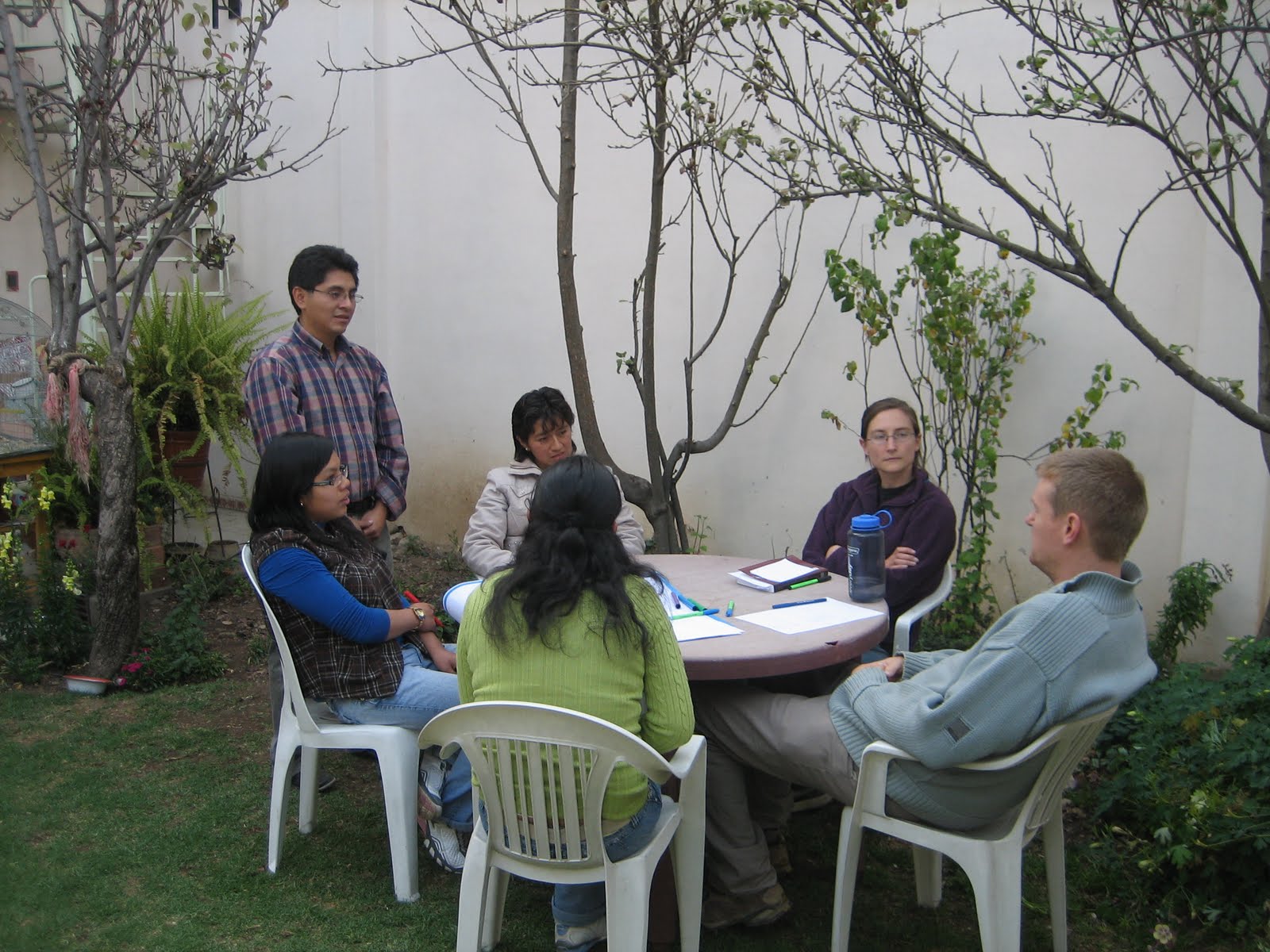
Marco (a Peruvian colleague) and I facilitated a Training of Trainers 1 (TOT1) in Huancayo, Peru, for two different mission organizations.

We split up into small groups frequently. Above one mission organization is discussing future plans.
Here's another way of working with small groups: the group above is trying to put in chronological order the steps to implementing Community Health Evangelism (CHE).

Above is a skit: we frequently do a river-crossing drama to illustrate the differences between relief, betterment, and development. In this part of the skit Paul has "hurt" his back carrying Rocio to the island in the middle of the river (relief), so he has no choice but to teach Karen how to cross (betterment going towards development). Then he leaves, and Karen teaches Rocio how to finish crossing the river (multiplication).

And here is a view of the mountains we crossed going from Lima (Pacific coast) to the high valley where Huancayo is located. I've read different estimates, but it appears we got up to nearly 16,000 feet (5000 m). Huancayo is just under 11,000 feet (3300 m).

Thursday, August 5, 2010

Future Plans


I've spent the past few weeks preparing for two big events:

1) Training of Trainers 1 in Huancayo, Peru! Two mission organizations have requested Community Health Evangelism (CHE) training there. A Peruvian missionary, who is already using CHE in another part of the country, will facilitate this five-day training with me at the end of August.

2) Move to my temporary assignment in Haiti! In mid-September I will arrive in Cap Haitian, the second-largest city in Haiti. This northern city is also the headquarters for Medical Ambassadors Haiti, and the four Haitian facilitators who are the core of this team have invited me to work alongside them for six months. I'll spend the first few months learning the language and accompanying the team to trainings and site visits, while I also take advantage of my English skills and work on project proposals and continuing relationships they've begun with other non-governmental organizations (NGOs).

Some of the people with whom I'll be working. The woman in the yellow t-shirt is Mme. Grimard, one of the four facilitators with Medical Ambassadors Haiti.

I'm to travel to Port-au-Prince monthly. There were two CHE programs there before the earthquake which are still trying to recover. There are also lots of pastors and NGOs who are looking for ways to move from relief to development and we want to be available to work with anyone who is interested in using the CHE tools.

Since so many of the Haiti CHE programs are involved with local clinics, one way that I will be able to help is with my medical skills, both in consulting and working alongside the nurse auxiliaries. Please pray for me about this: I haven't practiced medicine for three years and although I saw a few malaria cases in the States I have mostly only read about tropical medicine -- 13 years ago in the first year of medical school!

This is a great hand-washing system that we teach: there is a stick this man is stepping on which tips the bottle so that a small stream of water comes out. Soap is hanging next to the bottle, protected from rain by a plastic cup. This particular "tipitap" is right next to the latrine at the Bayeux clinic.

Monday, December 14, 2009

Visit from my coordinator

My coordinator, Bibiana, came for a site visit a few weeks ago. What a wonderful opportunity to learn from her! Above you see three Brazilians from a group working in Berisso expanding on their vision of community transformation and where they see CHE fitting in with that. One of the challenges of this bright, dedicated group is that almost all of them are studying at university and/or employed, leaving them less time for ministry in the community.

Bibiana is my "coordinator" rather than my "supervisor" since LifeWind has a non-hierarchical organizational structure. In turn I "coordinate" CHE ministry in Argentina, working alongside of (not over) local teams. Here we are listening to Horacio describe his vision and passion for Baradero. A great discussion followed about how CHE and church-planting/growth can actually be one thing (not two) if a vision for holistic transformation, multiplication, and development -- rather than relief -- is adopted by the church. Very exciting!

Above you see Bibiana with the Baradero team: Silvia and Horacio, Nora, Marisa and Alejandro.

Tuesday, November 10, 2009

Trip to Misiones - Training and Eating

The church where the vision seminar was held on Sunday morning. We had been planning on doing it the night before but the pastor was busy all evening putting back together the bridge you see that was destroyed by recent heavy rains.

Here's a close-up of the church. We had participants from three different denominations but segregated the small groups by gender due to the hosting pastor's preference. Gender and faith issues have been coming up a lot recently. I won't get into a lot here, but I will just note that women preach in this Pentecostal church, although men and women sit on different sides of the aisle -- or different sides of the circle, with the set-up we use in our trainings -- and all women have to wear skirts (I have now added one to my travel list, I had to borrow one this visit).

In several Brethren churches I have been to here women are not permitted to preach or teach adult men and they often wear head coverings. However they do sit mixed together with the men!

Ah, an idyllic scene. While I've grown accustomed to chickens entering buildings where we were doing trainings, on this day one of these cows tried to come in the front door! Thankfully one of the participants got up and shooed her away.

Here's most of the group that came to the seminar. In addition to talking about what is involved in starting a CHE program we discussed "The Great Commandment and the Great Commission," or God's plan for us to love God with all our being and love our neighbor. I also gave a lesson on relief vs. development.

Yum! They invited me to stay for lunch afterwards: chicken with pasta -- in the big bowl -- and a funky side dish from Misiones, flour mixed with grease (I swear those are the two ingredients I remember! I'll update this when I can think of the name)

Trip to Misiones --Travel

This is the first in a series of picture-dense postings about my trip last week to Misiones Province (Argentina) and Foz do Iguaçu, Brazil.


I stayed in Puerto Esperanza some of the nights and this is a restaurant I passed on my walk to the bus station. I want to know if that DiscoChef can dance?


This is my bus arriving to take me to the nearby town of Wanda, where my contact Ricardo lives during the week. He had scheduled a meeting with some people from his church who were interested in CHE.

I'm really glad the windows are open, it's HOT!

Above is the bus terminal in Wanda.

It's Saturday morning and we're ready to go to Colonia Lanusse, a rural area, so that I can give a vision seminar to people interested in CHE. This is Carlitos' truck. He drove really quickly on the dirt roads that were heavily rutted by the recent rains. I'm glad I didn't come back with him that day: he opened up the oil tank (?) on his car and they had to walk a ways and hitch a ride back to town.


We pulled over to the side of the road to let this truck go by. In this picture you can sort of see how rutted the road is, since at this point the cab is leaning one way and the trailer another. Pine trees are not native to the area but have become a big crop in the past few years.

How beautiful is this?


Carlitos, Ricardo, and Emilia sharing tereré on the porch of Ricardo and Emilia's country home.

Above is Emilia's wood-fired stove. She'd made a yummy soup for lunch, which (of course) included manioc/cassava, very popular in this part of the country.