Showing posts with label TOT1 (about my job). Show all posts

Friday, February 10, 2012

Grand Goave, southern Haiti, part 4

Those of us staying in the village (three trainers and two interns) were given a “first breakfast” of boiled plantains and yams. This was served with a different sauce each day, sometimes with fish or hot dogs in it. Our “second breakfast” was later in the day with the Training of Trainers (TOT) participants, and was spaghetti nearly every day. This is a traditional Haitian breakfast, and we were offered canned tomato paste, ketchup, Tobasco, and mayonnaise for toppings. Lunch was rice and beans with either fried chicken legs or a meat and vegetable sauce.

After the participants went back to their mountain homes, we would pack up from the day (we emptied out the training center, a local church, each night), discuss the day, walk down the back of the mountain to get water, bathe.

Above is one of our master trainers, Erigeur, with the indefatigable Gena.

Here is the local watering hole: kids collecting water in buckets on the left, people of all ages bathing on the right (including me the day before -- every other day I elected to bucket bathe on top of the mountain).

Then we were served my favorite meal of the day: labouyi. This is a porridge made of plantains, milk, and sugar. Mmmm..... They turned on a generator for an hour or so, then it was bedtime.


Above you can see an intense game of dominos being played (center) and a girl having her hair done (left). The guys are wearing hats because it's cold.


We stayed in a one-room cabin which was normally used as a meeting room and which, as you can see, allowed all the cool air to blow in. It wasn't so bad at 8 pm (the time of this picture), but got really chilly as the night wore on. The first night none of us really slept due to the cold and pain -- most of us were sleeping almost directly on the concrete. And have I mentioned the donkeys and their bizarre, loud braying? The second night we hung up extra sheets to block the wind, and we were loaned hooded sweatshirts and more blankets and padding. I should have taken an early morning pic of my fellow trainers looking like mummies -- covered from head to toe to block out the cold.

At the end of one of the days I used up my laptop battery correcting one of the supplements we use. A lot of our materials need revision, and this one was difficult to read due to several translation and spelling errors. I could have revised materials every evening if I would have charged up my laptop while the generator was running each night. (One night I did request to charge my cell phone – they had to remove one of the 13 cell phones that were plugged in at the house with the generator to make room for mine.)

I didn't ever re-charge my computer, though. Our days were already long, and I was really tired at the end of every day – when I wasn't facilitating a lesson I was interpreting everything (both what the facilitators said and all of the participants' comments) for our Canadian interns.

So, I thought I might end up here (one of many tiny cemeteries dotting the landscape) due to my rigorous schedule of late. However, the mountain air and walks were so refreshing -- God is gracious and his love is never ending!

There were lots of challenges with this training. Several of the participants had a hard time grasping the volunteer nature of our program. In addition, I think a lot of them went away thinking that Community Health Evangelism (CHE) is exclusively spiritual. This happens a lot – people either think that all we do is community health and development, or all we do is evangelism. It takes a mental shift for people to see that, in a kingdom of God mindset, they can all happen together. This mental shift can happen during a TOT, and many of our lessons are about the holistic nature of the gospel and examples of how CHE works practically.

Yay! Here we all are at the end of the training! And one final big thanks to Lydia Hamilton, who took most of the pics in this blog post.

Grand Goave, southern Haiti, part 3


Adorable children! These girls frequently stood outside the building where we had the training and often would start dancing when they perceived that they were being watched. ;-)

At one point we separated the class into two groups to put the steps to implement a Community Health Evangelism program in order. Then a couple of "moderators" from each group were chosen to look at the other group's responses as they were discussed.

It got a little heated! Each group wanted more "right" answers (not really the spirit we were going for).


Above you can see Gena (pink shirt) laughing at it all. She got our water every day (see the first post in this series), something that was one of her daily tasks anyway for her extended family.


This is where Gena lives with her extended family, which includes her uncle, a prominent leader in the community and our host. We stayed right next door.

Above you can see another donkey. Again, I would like to ask, what is up with the braying?

Once more I would like to thank Lydia Hamilton who took most of the pictures used in this post.

Grand Goave, southern Haiti, part 2


Did you know that donkeys bray any time, day or night? And it's freaky weird and loud and goes on longer than you would think.

Part of the Training of Trainers 1, which trains one of the critical groups involved in a Community Health Evangelism program, has the soon-to-be trainers come up with their own sketches to introduce the subjects that they will be teaching in the future. This is one of my favorite parts of the training, since it always involves a lot of laughing!

In the above picture the group presented a story about a man with a serious headache (who has already gone to the doctor) who asks some of his friends to pray for him. They said that they would go get people from the church to come over some time "later." They were trying to illustrate how people in the church are either not trained or are unwilling to pray with others, instead relying on the "experts."

We were all laughing during this sketch for a few reasons -- none of which were intended by the group, unfortunately. Firstly, the physical position that the protagonist adopted for most of the sketch is one usually associated with diarrhea. Secondly, the protagonist was played by Jackson, who'd made us laugh all week already. You see, during the first session of our training the participants come up with the "rules of the game" that they agree to follow: telephones on vibrate, respect others' opinions, etc. They also come up with a punishment. This group decided that people who violated the rules would have to dance (or drink a gallon of water, but no one took that option).

Jackson ended up leading the rule-breakers in their dances to make sure that they really danced. He would do crazy motions and make the others follow, saying, "Lower, really get down!" or "No, your other hand in the back!"

Above is another group's sketch about the importance of evangelism. The two people seated are bound with pieces of paper which say peche, or "sin."

Above you see another sketch about the importance of taking care of the environment. The woman is miming the typical way of cooking while the ground near her is littered with trash.

The above picture is for my Arizona church -- I felt "at home" when seeing this all around! (Yucca, isn't it?)

Yet again I would like to thank Lydia Hamilton, who took all of the above pictures.

Grand Goave, southern Haiti, part 1


This has been a season of travel – since late October I've been “home” in Cap Haitien only a handful of weeks. My last travel blog post was about my time in Peru. After that trip I was home for four days followed by:
  • Leogane, southern Haiti: Training of Trainers 1 for a partner mission organization
  • Cap Haitien, northern Haiti (home): Christmas and New Year's and office time
  • near Cabarete, Dominican Republic: vacation with our Canadian intern family!
  • Santiago, DR: helping Marie, the wife of our Haiti director, get medical treatment
  • Grand Goave, southern Haiti: Training of Trainers 1 for a partner mission organization
  • Santiago, DR: return to continue Marie's medical visits
Today I want to write about Grand Goave – what a great trip! I went there last week as one of three facilitators in order that I could also interpret the TOT into English for our Canadian interns, Rick and Rhonda, who hadn't yet taken a TOT1. Except for some car sickness and lots of waiting, we traveled there uneventfully – flight from Cap Haitien to Port-au-Prince, then a several-hour drive from there to the city of Grand Goave, where we stayed overnight and then went via truck up into the mountains the next morning (pictured above).

The whole area is incredibly rocky.


Above is the path down the back of the mountain where our hosts got our water for bathing. I hauled up a gallon container (and had to stop a few times to rest), while our host effortlessly carried a 5-gallon bucket (40 pounds!) on her head.


Above you see Rhonda going back up the hill.


This, again, is the PATH. Crazy with rocks!

Every day we woke up with the sun (or earlier, due to the cold). I hiked up to the top of our little mountain in the mornings to have some prayer time at a beautiful overlook.


Above is the road as it flattens out at the top.


This is the view of the bay and the town of Grand Goave.

A special thanks to Lydia Hamilton (daughter of our Canadian interns) for the photos in these posts on Grand Goave!

Thursday, October 14, 2010

Training in La Gonave


Here's the group of new trainers! This photo was taken at the end of the Training of Trainers 1 in La Gonave.

This trainer is presenting his groups ideas on how to obtain information from the communities in which they serve. Instead of formal (and often inaccurate) surveys, the groups suggest spending time forming relationships, talking with village elders and children, and using their five senses in observation.

In groups of two the trainers practice sharing about God's plan for us to live abundantly.

In between classes we use songs and dances to keep ourselves awake and keep the training fun. In Nicaragua I had learned one with lots of movements about planting and harvesting corn. While in Bolivia the group we trained invented a version using yucca (which has about twice as many steps!). Both corn and yucca are big crops here. So with Kreyol translation in hand, here I am leading the group in the life cycle of yucca! Haha! They had to show me the "real"movements since of course they know much more about yucca than I do.

We use a lot of sketches, too. Above you see trainers acting out the story of the paralytic and his four friends going to Jesus. We use this story to talk about key concepts in development: finding and using local resources, perseverance, love, and hope.

Here are my co-facilitators and our host: Enoch, Erigeur, Enick (our host), Lucson, and Sully (Enick's colleague). In this picture we're on a hill on the island and you can see the sea and the mountains of "mainland" Haiti in the background.


Wednesday, October 6, 2010

Travel to La Gonave


Lucson and Eriguer, two of my fellow training facilitators, enjoy yucca as our ferry is about to leave the port.

Steps to get to a training on La Gonave Island:

02:30 am Wake up since a truck has stopped outside with loudly-miked religious music (voudou). It stays there for about 20 minutes.

3:30 am I lift the heavy iron bar off from the outside gate of my lodgings (more Jane Austen) to let my co-facilitators in to pick up our training supplies.

3:40 am Wake up porter to lock the gate behind me. Leave hotel via pre-arranged taxi to the center of Cap Haitien.

3:45 am Taxi stops to pick up another few people along the way, so we are seven adults and one child in the car.

3:46 am The child sees me (it's dark) and says, "Blan!" (foreigner) I greet her with, "Bon jou." She doesn't respond, and her mother says, "She said 'Bon jou,' how to you respond? Come on, she said 'Bon jou.'" The girl looks at her mother and inquires, "In English?"

4:00 am Find our beautifully decorated (formerly yellow) school bus that is en route to Port-au-Prince. Using the light of our cell phones we find our assigned seats (three to a seat). While waiting, we can buy plantain chips, cell phone credit, water, etc.

5:00 am The bus roars out of town. At the top of a mountain someone calls for a bathroom break, so a bunch of people get off the bus (and go to the side of the bus). Um, this is why women tend to still travel in skirts even though in the past few years pants have become more acceptable. Since we're at a market, it's also a great opportunity to buy bananas, yucca, and peanuts from the vendors who come up to the windows.

10:30 am We yell at the driver to stop as we approach our destination, a port town. We yell again, until he finally stops. We get off and walk back to the port.

Enoch (the other facilitator) and me as we leave the "mainland."

11:00 am The ferry leaves. A man in a suit takes out a (miked!) megaphone and starts yelling at us that we need to accept Jesus today or we will die. He then gets into highly controversial doctrinal issues, all at a really high volume. People respond, argue back, etc. What I like best about all this is that the evangelist really resembles Chris Rock.


12:30 pm Arrive at La Gonave island. We can't reach our contacts by phone so we eventually decide to pay someone to take us in the back of his pickup truck to town.

3:00 pm Start the training for 16 participants who represent about eight different organizations!

Saturday, September 25, 2010

Bayeux Clinic

A few days ago I went to the Bayeux Clinic. This formerly self-sufficient clinic sustained damage in the January earthquake, as well as other damage from initially poor construction. They have received donations for reconstruction, including from my sending church, Epic Christian. Above you can see that they are already moving ahead. A contractor from a church in the neighboring Dominican Republic has made several trips to the site to advise them and work with the construction workers.

Here is a picture of what will be the new storage facility for the pharmacy, on top of the laboratory. The old storage facility was too damaged to be saved.

I hope to go out here every week or two to assist the (very capable!) nurse auxiliaries. My medical knowledge is sure to come back rapidly with the wide variety of cases they have there. On our way back to Cap Haitien we took a woman with severe pre-eclampsia to the "big city" hospital.

Above is the Cap Haitien office of Medical Ambassadors Haiti in action: Evelyn, Anias, Enoch, and Lucson. I'm here when I'm not traveling -- it's on the same site as my lodgings, which is awfully handy!

Next week I'll be at a Training of Trainers 1 we're facilitating for an organization on the island of La Gonave. If you look at this map you'll see both Cap Haitien and La Gonave -- it's the big island in between the two "arms" of Haiti. If you zoom in you can even see Bayeux, on the north coast (written "Bayeau, " it's on the coast west of Cap Haitien). This should be a great opportunity for more language learning!

Saturday, August 28, 2010

Peru -- training!

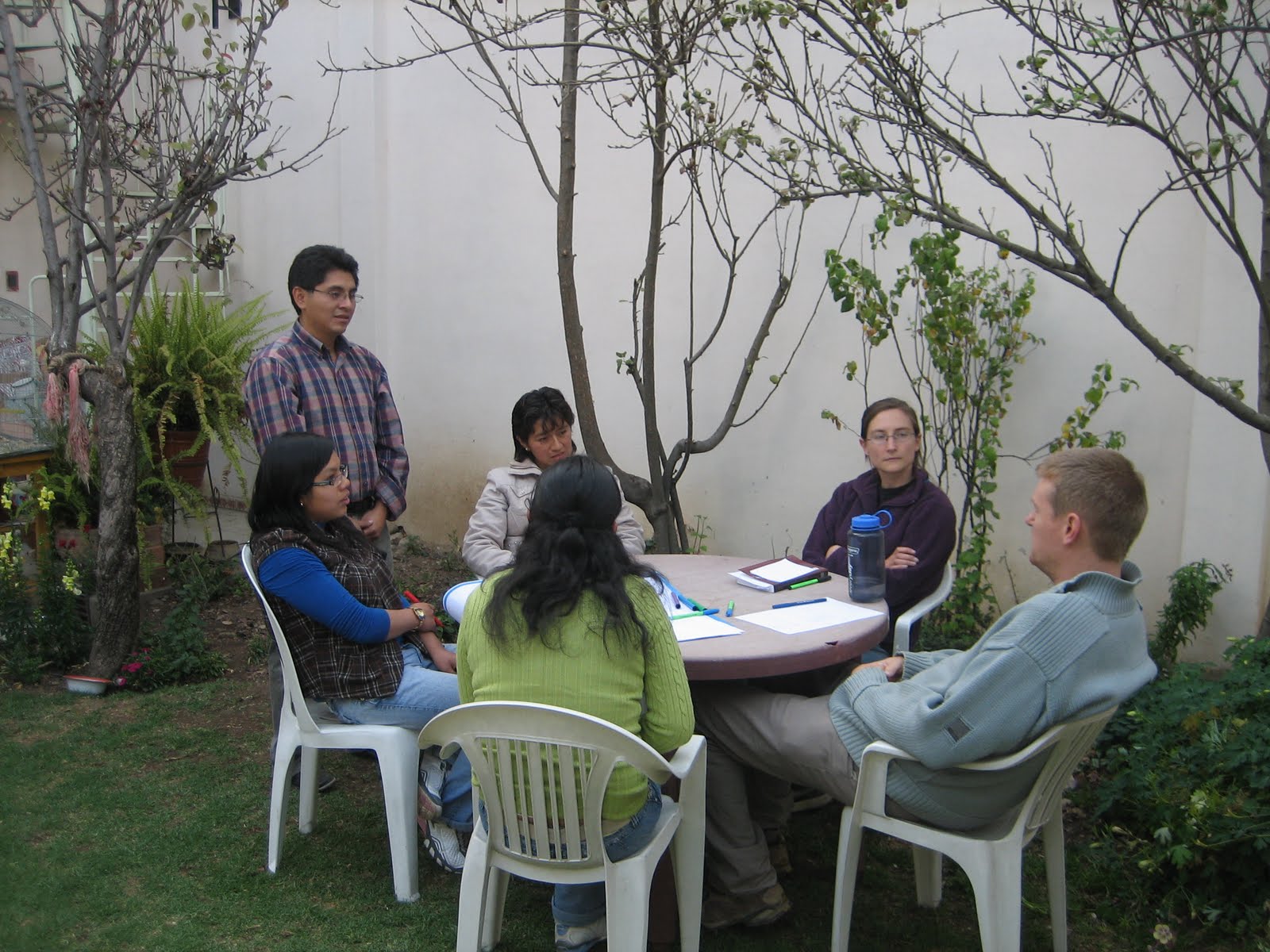
Marco (a Peruvian colleague) and I facilitated a Training of Trainers 1 (TOT1) in Huancayo, Peru, for two different mission organizations.

We split up into small groups frequently. Above one mission organization is discussing future plans.
Here's another way of working with small groups: the group above is trying to put in chronological order the steps to implementing Community Health Evangelism (CHE).

Above is a skit: we frequently do a river-crossing drama to illustrate the differences between relief, betterment, and development. In this part of the skit Paul has "hurt" his back carrying Rocio to the island in the middle of the river (relief), so he has no choice but to teach Karen how to cross (betterment going towards development). Then he leaves, and Karen teaches Rocio how to finish crossing the river (multiplication).

And here is a view of the mountains we crossed going from Lima (Pacific coast) to the high valley where Huancayo is located. I've read different estimates, but it appears we got up to nearly 16,000 feet (5000 m). Huancayo is just under 11,000 feet (3300 m).

Thursday, August 5, 2010

Future Plans


I've spent the past few weeks preparing for two big events:

1) Training of Trainers 1 in Huancayo, Peru! Two mission organizations have requested Community Health Evangelism (CHE) training there. A Peruvian missionary, who is already using CHE in another part of the country, will facilitate this five-day training with me at the end of August.

2) Move to my temporary assignment in Haiti! In mid-September I will arrive in Cap Haitian, the second-largest city in Haiti. This northern city is also the headquarters for Medical Ambassadors Haiti, and the four Haitian facilitators who are the core of this team have invited me to work alongside them for six months. I'll spend the first few months learning the language and accompanying the team to trainings and site visits, while I also take advantage of my English skills and work on project proposals and continuing relationships they've begun with other non-governmental organizations (NGOs).

Some of the people with whom I'll be working. The woman in the yellow t-shirt is Mme. Grimard, one of the four facilitators with Medical Ambassadors Haiti.

I'm to travel to Port-au-Prince monthly. There were two CHE programs there before the earthquake which are still trying to recover. There are also lots of pastors and NGOs who are looking for ways to move from relief to development and we want to be available to work with anyone who is interested in using the CHE tools.

Since so many of the Haiti CHE programs are involved with local clinics, one way that I will be able to help is with my medical skills, both in consulting and working alongside the nurse auxiliaries. Please pray for me about this: I haven't practiced medicine for three years and although I saw a few malaria cases in the States I have mostly only read about tropical medicine -- 13 years ago in the first year of medical school!

This is a great hand-washing system that we teach: there is a stick this man is stepping on which tips the bottle so that a small stream of water comes out. Soap is hanging next to the bottle, protected from rain by a plastic cup. This particular "tipitap" is right next to the latrine at the Bayeux clinic.

Thursday, May 13, 2010

Bolivian Training of Trainers

Above you see Nora filling out the three different forms required for entry into Bolivia. I also had a visa application which I needed to turn in at the airport, which thankfully went without a hitch -- well, once the visa processing people arrived. It didn't matter that I had to wait for my visa, though, since our next flight's itinerary had been changed to four hours later. As one of that airline's employees said with a shrug: Yeah, some days it leaves at 7 pm, other days at 11 pm.

Isn't the countryside beautiful? This is the Altiplano area, 4200 m (13,800 feet) above sea level. The day after arriving we were driven to the training site along with others who had flown in from the Amazon region of Bolivia. All in all there were 12 health workers from Samaritan's Purse who had come to learn how they could integrate spiritual teachings with their physical teachings.
We shared a time of worship every morning. You can't see him in this picture, but Ireneo is playing the plastic bottle! Yup, just put a few small rocks and dirt in a plastic bottle and you get another percussion instrument.

Here is Felix showing us what his group discovered about the worldview of the community they work in, from the roots (beliefs) to the trunk (values) to the branches (behavior) to the fruit (consequences).

Here you see Ireneo, Magaly, and Beatriz acting in a dramatization called "River Crossing Story," which illustrates the difference between relief and development.

End of the training, each participant with a certificate!

Time for a few last pictures just outside of our training site -- here I am with a herd of llamas.

And here is some llama on my plate! After a week of goat and sheep they offered us llama on the last day, which is surprisingly yummy!

Thankfully, the Samaritan's Purse secretary called to confirm our non-stop return to Buenos Aires that was scheduled to leave at 8:45 am. It turns out it left at 7 am and had a layover! :-)