Friday, February 10, 2012

Grand Goave, southern Haiti, part 2


Did you know that donkeys bray any time, day or night? And it's freaky weird and loud and goes on longer than you would think.

Part of the Training of Trainers 1, which trains one of the critical groups involved in a Community Health Evangelism program, has the soon-to-be trainers come up with their own sketches to introduce the subjects that they will be teaching in the future. This is one of my favorite parts of the training, since it always involves a lot of laughing!

In the above picture the group presented a story about a man with a serious headache (who has already gone to the doctor) who asks some of his friends to pray for him. They said that they would go get people from the church to come over some time "later." They were trying to illustrate how people in the church are either not trained or are unwilling to pray with others, instead relying on the "experts."

We were all laughing during this sketch for a few reasons -- none of which were intended by the group, unfortunately. Firstly, the physical position that the protagonist adopted for most of the sketch is one usually associated with diarrhea. Secondly, the protagonist was played by Jackson, who'd made us laugh all week already. You see, during the first session of our training the participants come up with the "rules of the game" that they agree to follow: telephones on vibrate, respect others' opinions, etc. They also come up with a punishment. This group decided that people who violated the rules would have to dance (or drink a gallon of water, but no one took that option).

Jackson ended up leading the rule-breakers in their dances to make sure that they really danced. He would do crazy motions and make the others follow, saying, "Lower, really get down!" or "No, your other hand in the back!"

Above is another group's sketch about the importance of evangelism. The two people seated are bound with pieces of paper which say peche, or "sin."

Above you see another sketch about the importance of taking care of the environment. The woman is miming the typical way of cooking while the ground near her is littered with trash.

The above picture is for my Arizona church -- I felt "at home" when seeing this all around! (Yucca, isn't it?)

Yet again I would like to thank Lydia Hamilton, who took all of the above pictures.

Grand Goave, southern Haiti, part 1


This has been a season of travel – since late October I've been “home” in Cap Haitien only a handful of weeks. My last travel blog post was about my time in Peru. After that trip I was home for four days followed by:
  • Leogane, southern Haiti: Training of Trainers 1 for a partner mission organization
  • Cap Haitien, northern Haiti (home): Christmas and New Year's and office time
  • near Cabarete, Dominican Republic: vacation with our Canadian intern family!
  • Santiago, DR: helping Marie, the wife of our Haiti director, get medical treatment
  • Grand Goave, southern Haiti: Training of Trainers 1 for a partner mission organization
  • Santiago, DR: return to continue Marie's medical visits
Today I want to write about Grand Goave – what a great trip! I went there last week as one of three facilitators in order that I could also interpret the TOT into English for our Canadian interns, Rick and Rhonda, who hadn't yet taken a TOT1. Except for some car sickness and lots of waiting, we traveled there uneventfully – flight from Cap Haitien to Port-au-Prince, then a several-hour drive from there to the city of Grand Goave, where we stayed overnight and then went via truck up into the mountains the next morning (pictured above).

The whole area is incredibly rocky.


Above is the path down the back of the mountain where our hosts got our water for bathing. I hauled up a gallon container (and had to stop a few times to rest), while our host effortlessly carried a 5-gallon bucket (40 pounds!) on her head.


Above you see Rhonda going back up the hill.


This, again, is the PATH. Crazy with rocks!

Every day we woke up with the sun (or earlier, due to the cold). I hiked up to the top of our little mountain in the mornings to have some prayer time at a beautiful overlook.


Above is the road as it flattens out at the top.


This is the view of the bay and the town of Grand Goave.

A special thanks to Lydia Hamilton (daughter of our Canadian interns) for the photos in these posts on Grand Goave!

Saturday, December 31, 2011

The Kingdom of God, birthdays, and 2012

On this bright and sunny birthday morning I finished reading The Unshakable Kingdom and the Unchanging Person. It was recommended to me by Jason Philbrick when I told him this summer that I'd been obsessed lately with the Kingdom of God.


Apparently the author, E. Stanley Jones, had someone tell him once that he seemed to be obsessed with the Kingdom of God. Jones writes that he then thought, “Would God that I were, for it would be a magnificent obsession. Jesus was obsessed with it, and to be obsessed with his obsession is to be on safe and universal ground. But I'm also obsessed with the person of Jesus, Jesus Christ.” This year I read through the Bible chronologically again and I drew a box around every time the Kingdom of God was mentioned and starred every time the Good News was mentioned, trying to grasp the full picture of it all. Reading Jones' book this past month has helped me to put some things together.


He emphasizes that the Kingdom of God and the parousia (the Second Coming) are not joined in Scripture. “The Kingdom was a vital and decisive issue now, while the Coming was delayed. This is seen from the fact that after the resurrection [Jesus] talked to the disciples about one thing for forty days. He talked to them of the Kingdom of God in the same terms as when he went about preaching the gospel of the Kingdom as a burning issue – now.”


The Unshakable Kingdom and the Unchanging Person was one of his last books – he was 87 when he wrote it. Here's the last paragraph: an great way to start my 42nd year of life and the new year 2012:


So that would mean that if we are to think and act as though the Kingdom were already here, if we have said personally that Jesus is Lord and have made a personal surrender to him with all we know and all we don't know, I belong to the Unchanging Person, and therefore we belong to the Unshakable Kingdom. Then I prayerfully consider how I can apply the Kingdom spirit and principles to all my relationships as far as it depends on me, to my personal thought, life, actions, and habits, to my family life, to my professional or business relationships, to my class and race relationships, to my recreational relationships, to my church relationships. I can't change everybody but I can change me and my relationships as far as they depend on me. In each of these I can say: As far as I am concerned the Kingdom is already here. In the light of its being already here, how do I think and act? I am certain of one thing about that kingdom, that the Kingdom is the kingdom of love. So I will begin to love, if not by my love, then with his love – for everybody, everywhere, I am a disciple to the kingdom of God, under its tutelage and control and unfolding sovereignty. I may make blunders and fall, but if I fall I will fall on my knees, and if I stumble I will stumble into his arms. I have a destiny – I am a seed of the new order – “the good seed means the sons of the kingdom” (Matt. 13:38 RSV). I am sown in this particular place to be the interpretation and meaning and message of the new order. I know the seed and the soil are affinities, so that all the resources of the Kingdom are at my disposal. So “in Him who strengthens me, I am able for anything.” (Phil. 4:11 Moffatt). I have a total Gospel, for man's total need, for the total world. I ought to be happy – I am!

Friday, December 9, 2011

Trujillo, Peru (part 2)

Every morning in Trujillo was spent preparing lessons (printer issues led to walking to sites which would print for us, then we walked to the photocopy shop, then to the internet cafe to prep my next trip, etc.). In the afternoons we did lessons in Barrio 6 A, then in Libertadores and got home in the evening.

A lesson on how to make oral rehydration serum in the home, for when children have diarrhea.

One evening on our way home we stopped by the town square. Above you see the beautiful cathedral in downtown Trujillo.

Check this out! My last day there I got to go see some amazing ruins. This is called the ruins of the "Sun Temple," since it is guessed to be a monument to the sun god -- although that is hotly debated, and some say it is only thought to be to the sun god because that's how they do things in Mexico (just a little ways away). Only 25% of this building is left intact, and it's still gi-normous! Excavation hasn't yet started.


This is one of the painted walls of the "Moon Temple" (again, see controversy above). This was painted some time around 400 AD using charcoal, calcium, and some plant extracts. These constructions pre-date the Incas; they were built by the Moche people whose civilization had disappeared by 800 AD.

Here is the facade of the Moon Temple. See the different stories? Every 80 to 100 years they completely filled in the story below with bricks and built a new one on top. Only the top two have been excavated so far, the rest are awaiting experts to tell them how to do so safely in an area so prone to earthquakes.

The rent in the center of the facade was caused by people who ransacked the temple for treasures centuries ago.

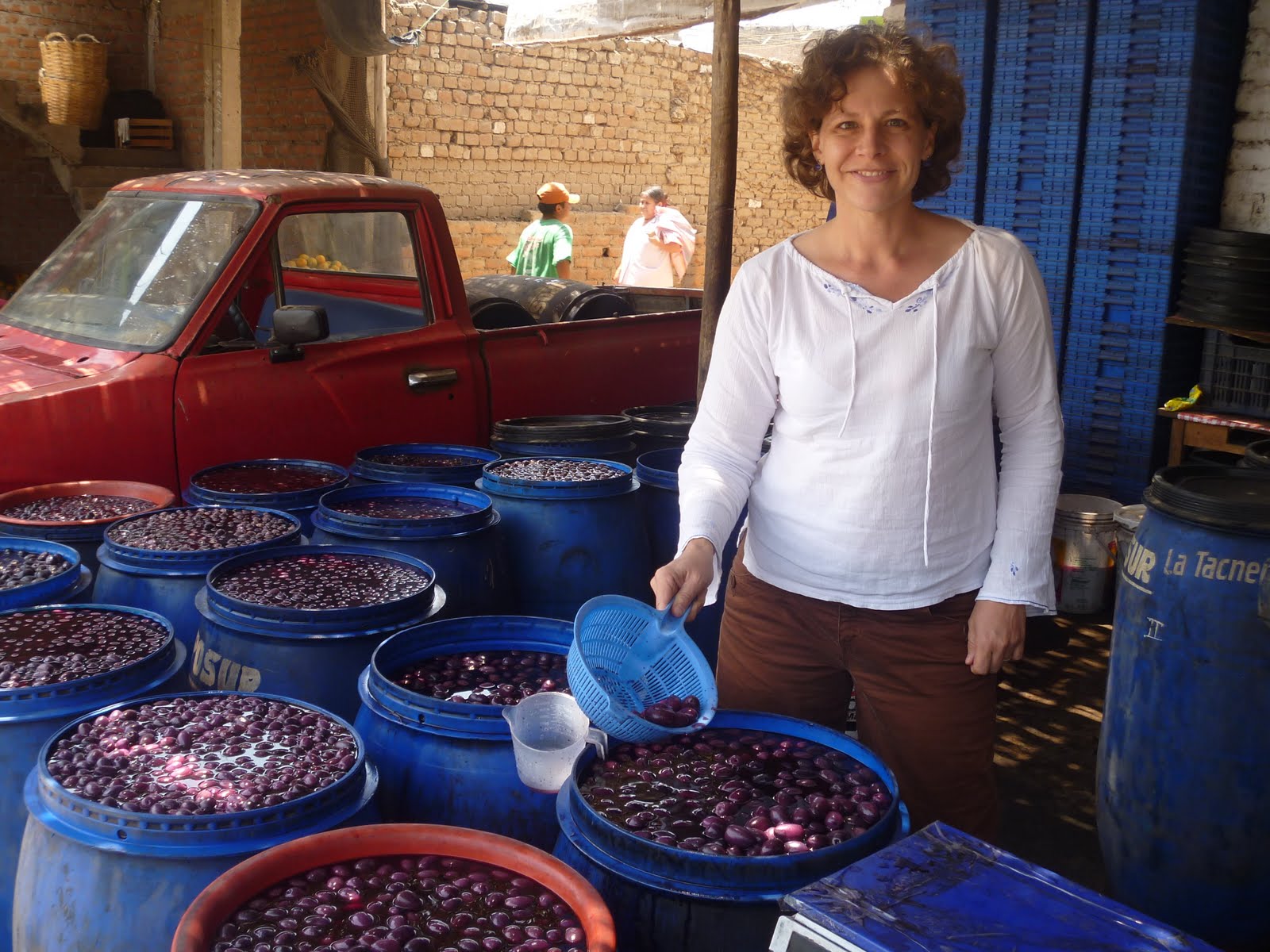
On our way to the airport my hosts drove me through a fruit market. Mmm... olives. I currently live in an olive-free zone and so my hosts said, "Let's stop and you can take a picture -- take it like you're selling the olives!."

Then my zany new friends said, "Pretend you're eating them!" So, here goes!

Marco and Vilma, my hilarious hosts, next to an incredible variety of fruit.

Trujillo, Peru (part 1)

I had the opportunity to go to Trujillo, Peru to do some trainings. Marco and Vilma, CHE trainers, have started CHE programs in two urban neighborhoods. Here I am with Vilma, posing in front of the boats that have been used for centuries there. Cargo (or a tourist) goes in the hollowed out portion and the rower kneels in the front!
.

One of the lessons we did was "Nutrition: 3 x 3." We separated food into three groups: protein, protectors (fruits and veggies), and carbohydrates. We discussed the importance of having all three groups at all three meals (hence 3 x 3).

The lessons I facilitated are usually done by trainers; I don't usually teach the Community Health Evangelists directly. In this instance, since Marco and Vilma are the sole trainers there in Peru, I went to provide a bit of back-up.

Marco and Vilma,Mmm, the Libertadores group made picarones for us this day -- the batter is made from wheat flour, sweet potato, and squash then fried and covered with syrup. My co-worker Marco tells me that this is a really big deal -- a few years ago there was an organization that provided food and/or money for every training. People only came when things were provided, and didn't contribute anything of their own. Now that they are truly implementing the CHE model the community members have started making treats and coming to trainings on their own initiative!


Tee-hee, this picarón is in the form of a dog!

Peru is known for its varied cuisine. Here I am with Marco and Vilma's family about to enjoy a traditional ceviche.

The day after our "3 x 3" lesson the "Barrio 6 A" group made ají de gallina for us all. They very cheerfully noted that it met the 3 x 3 standard: chicken, potato, and lettuce!

This is the drive between the two target neighborhoods. Marco and Vilma are both taxi drivers, so we had their (rented) cab for transportation. The neighborhoods are new, built over the past ten years on land which formerly was used as a garbage dump. The drive between the neighborhoods is through the current dump site.

There is no dirt here, only sand -- to grow anything you have to lay dirt down first. Many people cleared away the garbage first and then built a solid foundation for their house, although several sections were clearly built more precariously and without removing the trash first. Marco jokes that either way, they aren't showing wisdom because there are building their houses on sand! ;-)

Wednesday, October 19, 2011

Events Far Away

Phew! There's been a lot going on these past few weeks! But first, a few definitions important for this post:

A vision seminar is a one- to three-day event for people interested in CHE to see if we have a common vision for holistic community transformation and if they want to commit to sending people to a week-long Training of Trainers 1 (TOT 1). After trainers apply the principles they learn in a TOT 1 they participate in a TOT 2 which enables them to form and train a committee and Community Health Evangelists (CHEs).

In October alone we've got two vision seminars (Grand Goave and Leogane, both in West Province), a TOT 1 near Jacmel (Southeast Province) and a TOT 2 on the island of La Gonave (West Province). Our office is in North Province. I'm won't actually be present at any of those events but I've been involved in most of the planning since we are organizing them with other NGOs and the communication has mostly been in English.

Last Saturday the vision seminar was held in Leogane. During the starter for the first lesson everyone was given a piece of paper and told to find the "match." "Soccer player" and "ball","hair stylist" and "scissors."

One woman got "door" and found "key," who just happened to be a pastor. The assignment was to exchange information about each other - why they came to the seminar, where they were from, family info -- and then present each other to the group. She decided to tell this pastor about her faith journey -- she had been considering Jesus for a long time but continually felt blocked at the point of making a decision. And then she decided to follow Jesus! They shared this decision with the larger group and everyone prayed together and welcomed her into the family. We rejoice along with her because of God's persistence, mercy, and love!

This month we're also celebrating International Handwashing Day with activities throughout the month, not just on the day. In addition to all of this Osse -- the director of Medical Ambassadors Haiti -- and I will be traveling to Argentina for our Regional Council. We'll stay afterwards to facilitate a TOT 1 and 2. All told, I will be traveling from October 28 to December 6:
  • Continuing medical education conference in Orlando, FL

  • Regional Council (Caribbean and South America) in Cordoba, Argentina

  • Facilitating a TOT1 and 2 in Cordoba, Argentina

  • Travel to Buenos Aires to see friends!!

  • Trujillo, Peru to facilitate a training of CHE workers

  • Lima, Peru to meet a contact interested in working with CHE

Thursday, September 15, 2011

A day in the life

Wednesday, September 14

Woke up looking forward to my breakfast, chiefly for the caffeinated portion of it since throughout most of the night it was 88 and humid. I breakfasted with a woman from France who has come to work with the music school (at which I volunteer) for the year. Conversation in French and Kreyol, hah!

At the office we spent time in prayer and singing as we've been doing every day lately (yay!). We have a lot going on these days and it is so good to recognize the hand of “Gran Mèt la” (this is how the Kreyol Bible translates “LORD God”, but it literally means “the great teacher/master”). Some of our day's activities:

  • Look up flights – I have to go to Orlando for a medical conference next month, then straight-away to Argentina and Peru for meetings, trainings, and follow-up. My co-worker Osse will be going to Argentina, and since he doesn't speak Spanish or English should really travel there with me or our Dominican co-workers. Since we have internet today we start to look up flights, but are stalled by not knowing if he will be able to pass through certain countries without a visa. We try to call consulates but the phones aren't working – it is suspected that the new internet company is combining with one of the major telephone companies and their work has interrupted service.

  • October 15 is Worldwide Handwashing Day! UNICEF has supplies: soap, buckets, posters. We work on filling out a request (in French, ouch) for these materials. In addition to our usual house-to-house teaching we'll be doing some local radio spots and events in schools and churches.

  • Solencia, a trainer and friend, comes to the office. She's had an abscess on her leg that she would like advice about. I examine her leg. She also tells me about her godmother's uncontrolled asthma, Solencia is worried about her. I give her suggestions for her godmother to take a preventive medication regularly, along with a list of steroid inhaler options (I don't know what's available here).

  • A team of four is coming from Detroit next week to make badges for our volunteers and see the communities where they work. We discuss again which communities we'll be going to on which day and make a few changes to the schedule.

  • Dina, a woman who recently moved here from Nicaragua to marry my former co-worker Enoch, comes in the office to discuss a lesson she needs in Kreyol, one of the basic ones we do upon starting to train our trainers to work with perinatal topics. We don't have this lesson in Kreyol yet and had quickly translated just the supplement for a training last Saturday, but Dina would like the entire lesson today for a training she's planning in a village tomorrow.

  • We fill out a report for the Ministry of Health on last month's activities. As much as possible we try to work together with the government authorities.

  • Osse and I will be going to Port-au-Prince at the end of the month for a meeting with the Association of Christian Health Organizations. We contact those in Port-au-Prince that we've trained to see if they would like to meet.

It's late and my co-workers Evelyne and Osse are getting ready to go home. Anias, another trainer, comes in the office to collect his things and start his 1 ½-hour motorcycle ride home. We hear raindrops starting on the tin roof. He pauses, and it starts pouring. Anias says, "Well, I could leave my bag here, with all my life in it. And my shoes so they don't get wet." Osse answered, "And your clothes!" Anias: "Great idea! All the other vehicles would move aside: get out of the way, there's a crazy naked guy on a motorcycle coming our way!"

Anias leaves (clothed) and Evelyne and Osse decide to wait a little to see if the storm will subside – they are leaving by motorcycle too. We have to shut the windows because the rain is streaming in and it's steamy hot. The internet stops working due to the rain. We go into the second room of the office because it has a ceiling which muffles the sound of the rain. A group for which we will be doing a training in the south next month has sent us an old lesson they would like to use if we think it's appropriate for CHE work in urban settings in Haiti, since that's where some of the participants will be working. Up till now the CHE work in Haiti has primarily been in villages. Since I'd downloaded it before the internet went out, I verbally translate it from the English for my co-workers to see what they think. Nope. I translate another lesson that we have used in South America as an introduction to how to do CHE in urban settings – it's a go. Written translation of that will have to wait, though – the rain has slowed down a little and my colleagues leave.

I meet the woman who prepares my evening meal and take her blood pressure, since I also act as her doctor.

This morning I'd loaned the woman who washes my clothes some money – her son broke his leg and a few days ago she asked me for help. Tonight her brother – my mango supplier – comes over to thank me. He tells me that God also gave me a gift today – the rain made it cool enough that I should sleep well!